Musical Geometry • Tone • Melody • Harmony • Beat, Rhythm & Groove
Music is about rhythm and tone, geometry and emotion. It’s about movement of sonic patterns that move us

Beats and rhythmic patterns divide time and we feel this as movement in the body; we respond to music physically, psychologically and socially. It is an integral part of the human experience and culture globally.
Rhythm is at the core of music: it provides structure in which a piece takes place. In essence it is the pattern of sounds and silences, of notes and rests. In an ensemble, bass and percussion instruments are usually used as rhythm section, however any instruments may be used. Melody has rhythm too.
Fundamentally, rhythm is the movement between sound and its absence
Anything with a regular pulse is rhythmic. Some pulses are accented (which forms strong and weak beats) to create different grooves, just as stressed and unstressed syllables do in poetry.
Elements of rhythm include:
- Meter – groupings of beats
- Time signature – beats per bar or measure
- Tempo – speed, bpm
- Syncopation – off-beat
- Polyrhythms
Melody and harmony are created with tone – pitched sound. They give colour and shape to music. Tone has the following qualities:
- Pitch – a spectrum of low and high tones or frequencies measured in Hertz: vibrations per second – i.e. complete back and forth oscillations; determined by the fundamental frequency of a tone (see overtone series); logarithmic; humans can generally hear between 20 and 20,000 Hz
- Contour – the shape of the melody
- Loudness: the dynamics between relatively loud and quiet sound; dB, (pp, p, mp, mf, f, ff); measured by the amplitude of the soundwave
- Timbre – the texture of the sound; dependent on overtone configuration
- Reverberation
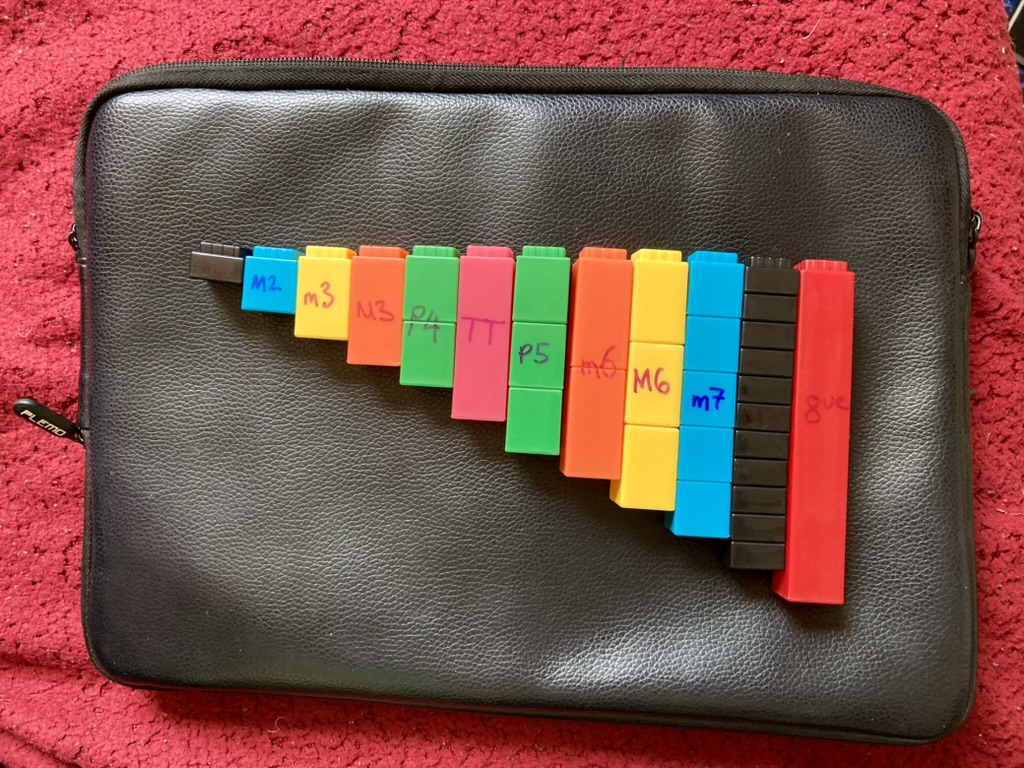
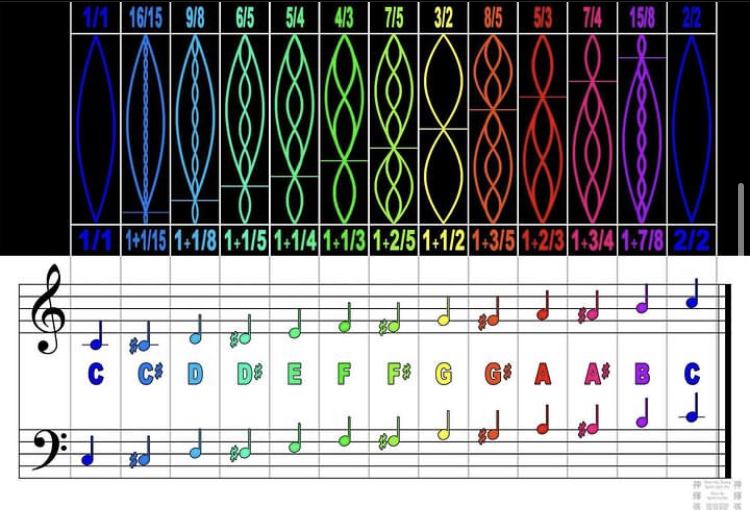
Tone is pitched sound – what we in the West understand as ‘high and low’ notes. the ‘distance’ – or more accurately relationship – between tones are called intervals and are at the heart of our perception of music.
Intervals create melody – consecutive notes and harmony – simultaneous notes.
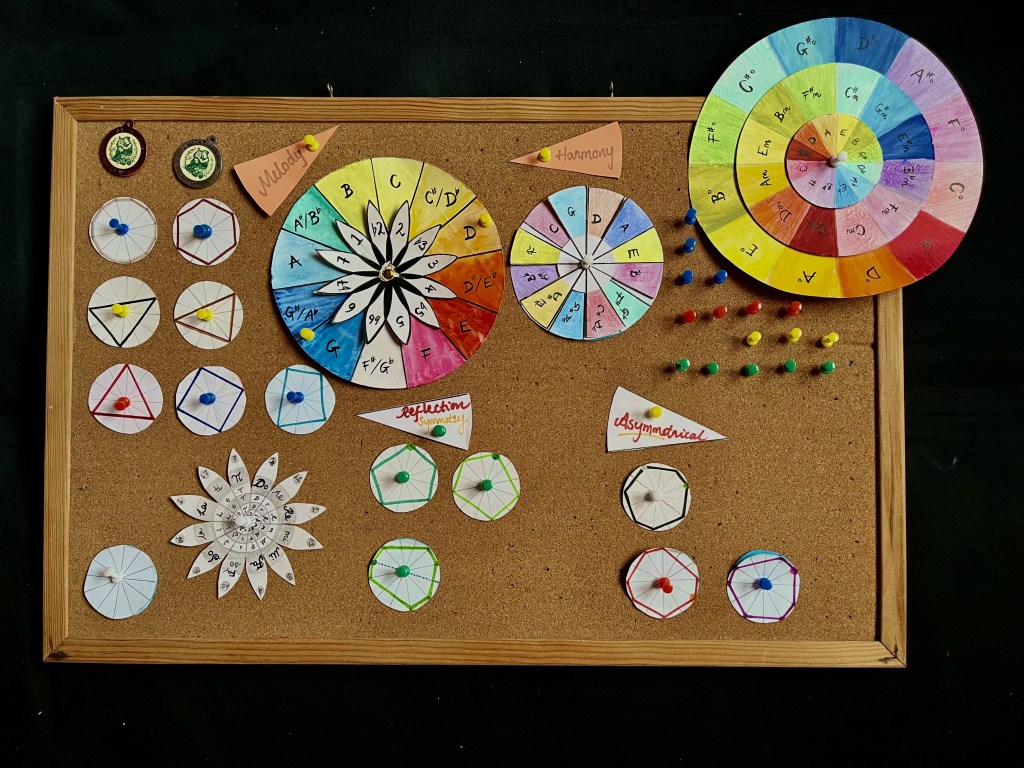
Chroma Wheel illustrates the 12 tone chromatic scale and its derivation the Circle or 5ths. Intervals, chords and scales can be plotted on the wheel to create transposable forms. See below.
In addition to angles around a circle, intervallic relationship can be expressed as ratios.*

Music Theory (from Greek theoria) literally refers to looking at sound. Such visual renderings can help us to see the basic elements of music, how and why notes are related in different ways and give us the formula for playing in any key, which makes transposition a lot easier.
We are not just memorising a bunch of scales and chord changes, we looking at their underlying patterns and structures and understanding these building blocks gives us a solid grounding and sophistication in our musical vocabulary. If music is language (which it is) then theory is its grammar and syntax. Chroma Wheel is a melodic map which shows note relationships through movement in 2D space and the colour spectrum.

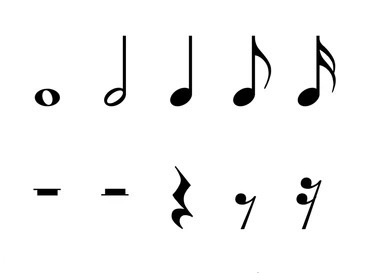
Note values
Rhythm
Stave
♫
 Music of Movement